Mac Read Memory App

Close unresponsive apps and processes
When your system is acting sluggish or simply not responding, an app or process may be the source of the problem. You can use Activity Monitor to locate the troublesome app or process and force it to quit.
Read reviews, compare customer ratings, see screenshots, and learn more about AmorphousMemoryMark. Download AmorphousMemoryMark for macOS 10.8 or later and enjoy it on your Mac. AmorphousMemoryMark measures memory module read/write performance in GB/s. Mac apps take long. The first prominent use of a RAM disk was to copy the Mac’s slow ROM (Read Only Memory), which contained many of the system’s core components, along with the operating system, which was stored on a floppy drive, and move them both to a RAM disk where they could operate at the speed of RAM; many, many times faster than either the floppy disk. Get rid of “Your computer is low on memory” virus alerts using Combo Cleaner removal tool. The Mac maintenance and security app called Combo Cleaner is a one-stop tool to detect and remove “Your computer is low on memory” virus. This technique has substantial benefits over manual cleanup, because the utility gets hourly virus definition updates and can accurately spot even the newest.
Memory Clean works by purging the Mac's inactive memory and is best used when you close an intensive program that you do not plan to use again quickly within a few hours. Controlled Cleaning With Memory Clean, you can set the app to automatically clean your memory when free memory falls below a defined threshold amount. The Mac maintenance and security app called Combo Cleaner is a one-stop tool to detect and remove “Your computer is low on memory” virus. This technique has substantial benefits over manual cleanup, because the utility gets hourly virus definition updates and can accurately spot even the newest Mac infections. Alfred is an all-in-one app designed to save you time with Mac shortcuts and convenient custom actions. You can use it in a variety of ways. For example, you can access Alfred’s clipboard memory so you don’t copy and paste the same material over and over, or set up custom workflows to automate some of your most repetitive tasks.
See how much energy your Mac is using
You can find out how much energy your Mac is using, and see which apps or processes are using the most energy.
See real-time CPU, network, or disk status in the Dock
It’s easy to keep an eye on your system status without even looking at the Activity Monitor window—you can monitor your CPU, network, or disk usage as a live graph right in the Dock.
To browse the Activity Monitor User Guide, click Table of Contents at the top of the page.
Activity Monitor User Guide
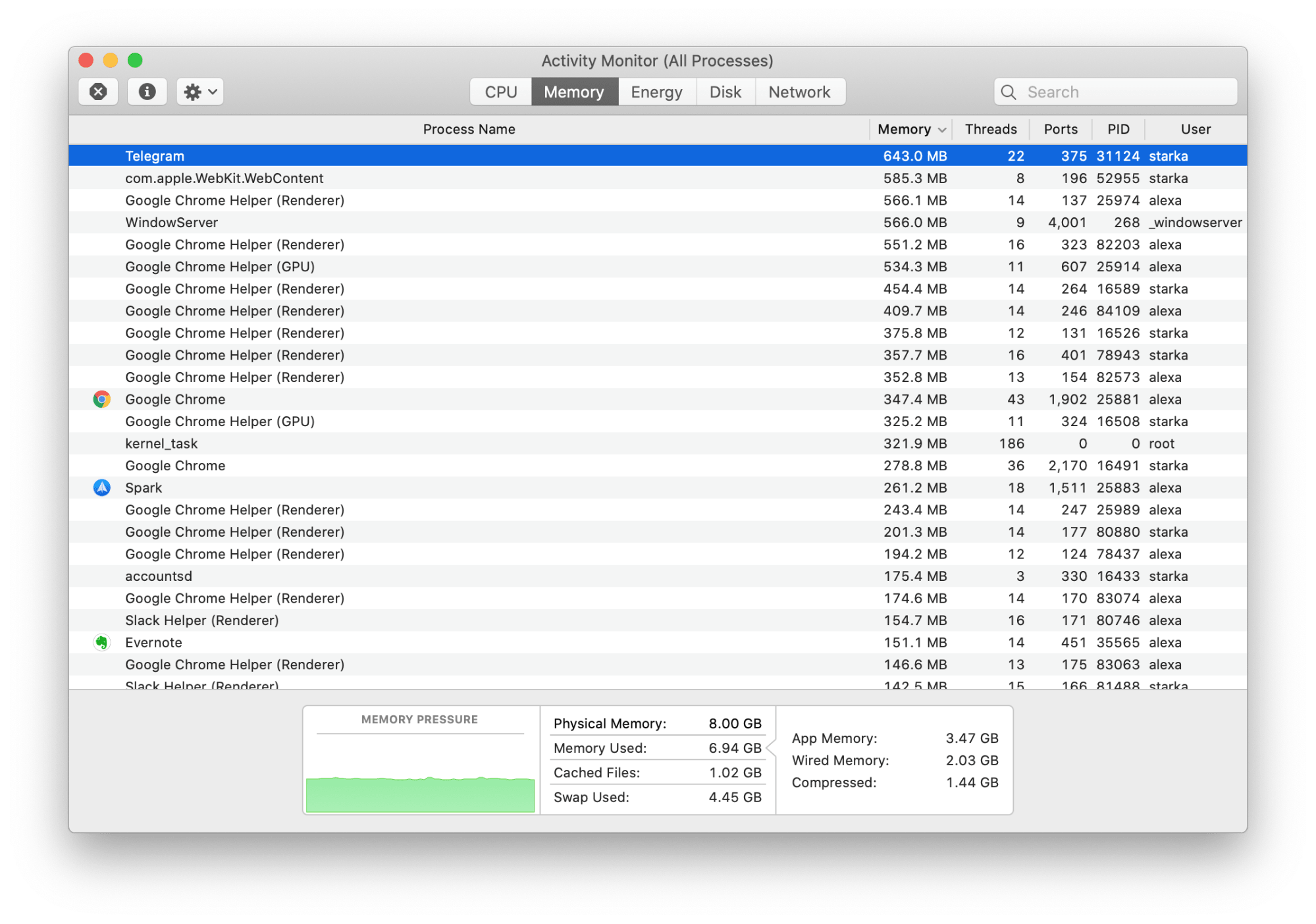
You can see the amount of system memory being used on your Mac.
In the Activity Monitor app on your Mac, click Memory (or use the Touch Bar) to see the following in the bottom of the window:
Memory Pressure: Graphically represents how efficiently your memory is serving your processing needs.
Memory pressure is determined by the amount of free memory, swap rate, wired memory, and file cached memory.
Physical Memory: The amount of RAM installed.
Memory Used: The amount of RAM being used. To the right, you can see where the memory is allocated.
App Memory: The amount of memory being used by apps.
Wired Memory: Memory required by the system to operate. This memory can’t be cached and must stay in RAM, so it’s not available to other apps.
Compressed: The amount of memory that has been compressed to make more RAM available.
When your computer approaches its maximum memory capacity, inactive apps in memory are compressed, making more memory available to active apps. Look in the Compressed Mem column for each app to see the amount of memory being compressed for that app.
Cached Files: The size of files cached by the system into unused memory to improve performance.
Until this memory is overwritten, it remains cached, so it can help improve performance when you reopen the app.
Swap Used: The amount of space being used on your startup disk to swap unused files to and from RAM.
To display more columns, choose View > Columns, then choose the columns you want to show.
Upgrade Mac Memory
You can use Activity Monitor to determine if your Mac could use more RAM.